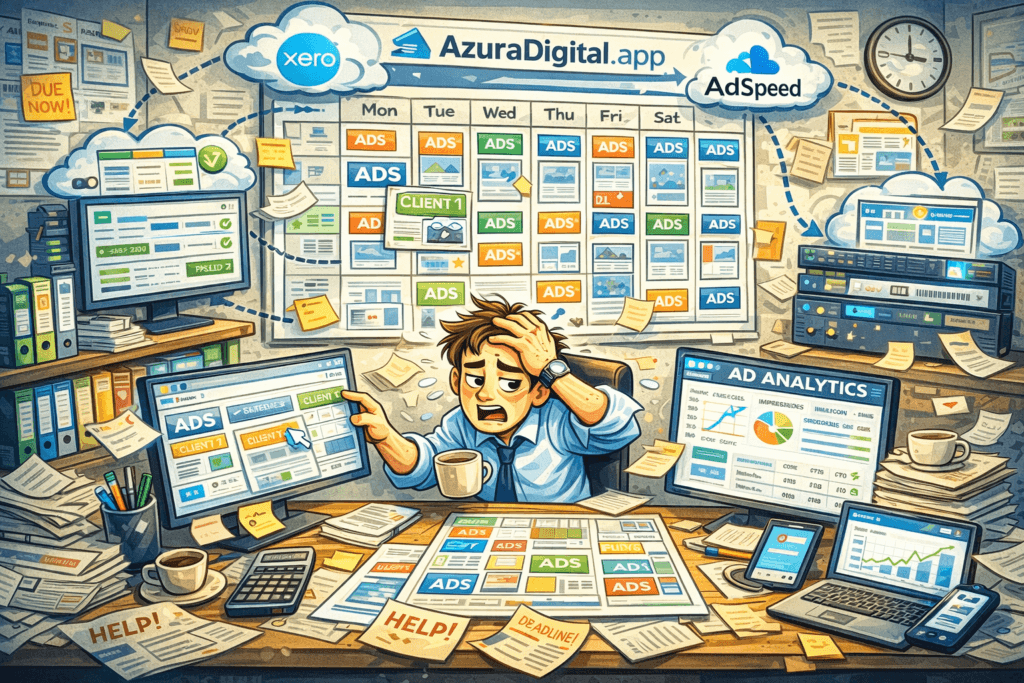
When a media business relies on advertising revenue, the operational infrastructure behind that advertising is not a back-office concern — it is the business. Every misplaced creative, every reconciliation gap between the booking system and the accounts, every email thread chasing outstanding artwork represents a direct cost: in staff time, in client frustration, and in the kind of quiet reputational erosion that accumulates when things don’t work as smoothly as they should. AzuraDigital.app is a purpose-built advertising operations platform developed specifically to eliminate those costs for Air Cargo Week — and the story of how it was designed, built, and integrated tells a great deal about what it actually takes to build mission-critical software for a specialist media environment.
The Problem It Was Built to Solve
Air Cargo Week (ACW) is one of the most respected publications in global air freight. It publishes across a website and a daily newsletter, carries advertising from the sector’s leading airlines, freight forwarders, ground handlers, and technology providers, and runs the World Air Cargo Awards — one of the industry’s most prestigious recognition programmes. Its advertising operation is correspondingly serious: multiple ad zones across multiple channels, campaigns running across different time periods, a mix of standard static formats and increasingly sophisticated HTML RichMedia creatives, and an advertiser base that expects transparency about how their campaigns are performing.
Before AzuraDigital, that operation ran the way most specialist media advertising operations run: through a combination of email, spreadsheets, and manual reconciliation between the commercial team, the production team, the ad server, and the finance system. Each of these systems did its job in isolation. The commercial team booked campaigns. The finance team invoiced them in Xero. The production team liaised with advertisers for artwork — via email, chasing manually when deadlines approached. The ad trafficking team loaded creatives into AdSpeed, the ad serving platform, matching zones and schedules as best they could from whatever information had made its way across from the booking records. When something went wrong — a creative in the wrong zone, a campaign that had run without being invoiced, an advertiser unclear on why their impression numbers looked the way they did — finding the source of the error meant retracing a chain of emails and manual entries.
This is not a situation unique to ACW, or to air cargo media. It describes the operational reality of a very large number of specialist B2B publishers. The software industry has never particularly prioritised their needs: the enterprise adtech market caters to large-scale programmatic operations, while the small end of the market makes do with booking plugins and shared spreadsheets. The middle ground — a professional, multi-zone, multi-channel publishing operation with complex campaign structures and genuine advertiser relationships — has largely been left to manage with whatever it can assemble.
AzuraDigital was built to fill that gap precisely.
Defining the Architecture Before Writing a Line of Code
The first stage of any complex application build is the most important, and also the most frequently rushed: the architectural definition phase. Before any development begins, every system the application needs to talk to must be mapped, every data flow must be traced, and every user’s experience of the system must be understood clearly enough to determine what the application needs to do — as opposed to what it needs to look like.
For AzuraDigital, four core integration requirements defined the architectural shape of the system from the outset.
The application needed to talk to Xero, ACW’s accounting platform, in real time. This meant that the same action — accepting an advertising booking — needed to simultaneously reserve the zone in the operational system and create the corresponding record in the finance system. Not sequentially, not with a manual export step, but as a single atomic transaction. This was the only way to guarantee that the commercial and financial records would remain in alignment, and that the reconciliation headaches of the old system would not simply reassert themselves over time.
The application needed to talk to AdSpeed, ACW’s ad server, with the same immediacy. AdSpeed handles creative rendering, impression logging, click tracking, and delivery logic for every ad zone across the ACW website and newsletter. Any change to a campaign schedule in AzuraDigital — a date shift, a zone reallocation, a creative swap — needed to propagate to AdSpeed via API instantly, without manual re-trafficking. The flatplan had to be the single source of truth, with AdSpeed as the execution layer beneath it.
The application needed to provide advertisers with a self-service portal through which they could upload creatives, set landing page URLs, view their scheduled placements, and access their campaign performance data without needing to ask anyone anything. This was both a client experience requirement and an operational efficiency requirement: every piece of information an advertiser could find themselves was an email that didn’t need to be sent and answered.
And the application needed to automate the artwork chasing workflow — the sequence of events between a confirmed booking and a campaign that is actually ready to run — in a way that provided both the production team and the advertiser with real-time visibility of status, and that triggered reminders automatically when deadlines approached.
These four requirements — Xero integration, AdSpeed integration, advertiser portal, and automated production workflow — defined the application’s scope before any interface design began.
The Live Flatplan: Operational Heart of the System
The centrepiece of AzuraDigital’s interface is the live flatplan — a visual, real-time representation of every ad zone across the ACW website and newsletter, stretching six months into the past and twelve months into the future.
A flatplan is a concept borrowed from print publishing, where it described the physical layout of a magazine issue — which pages carried advertising, which carried editorial. In its digital form within AzuraDigital, it serves the same purpose at a much higher level of sophistication. Every booking is visible on the flatplan as a block occupying specific zones and dates. The commercial team can see at a glance what is booked, what is available, what is confirmed and creative-ready, and what is outstanding.
The drag-and-drop functionality deserves particular attention because its implementation is more complex than it appears. When a commercial team member moves a campaign booking from one date range to another on the flatplan, they are not simply updating a database record. They are triggering an API call to AdSpeed that updates the campaign schedule in the ad server in real time. The visual action on screen and the operational consequence at the ad serving layer happen together, as a single transaction. This is what it means for AzuraDigital to be the operational control layer for ACW’s advertising — changes made in the application are changes that immediately affect what ads run where and when.
The flatplan also functions as a production workflow dashboard. Each booking block carries status indicators: whether the creative has been uploaded, whether the landing page URL has been configured, whether the campaign is flagged as display-ready. The production team’s view of outstanding work is not a separate report — it is the flatplan itself, filtered to show what is and isn’t ready.
API Integration in Practice: Xero
The Xero integration is perhaps the most commercially significant component of AzuraDigital, because it directly addresses the financial reconciliation problem that was, in many respects, the most costly aspect of the old workflow.
Xero is ACW’s accounting platform. It holds the financial record of every invoiced campaign. Before AzuraDigital, the connection between the commercial booking records and the Xero records was manual and periodic — bookings were confirmed in one system, then entered into Xero separately, creating a window of potential inconsistency that had to be managed through regular reconciliation runs.
AzuraDigital removes that window entirely. The integration works as follows: when a commercial team member confirms an advertising booking within the application, the system performs two operations simultaneously. The zone is reserved on the live flatplan, marking it as unavailable for any other booking. And a corresponding invoice record is created in Xero via the Xero API, carrying the campaign details, the advertiser information, the value, and the booking reference. Both operations either succeed together or neither proceeds — which is what genuine financial-operational alignment looks like in practice.
The same logic applies at the quoting stage. A quoted campaign creates a draft record in both systems, progressing through to a confirmed state in tandem. At no point does the commercial record and the financial record exist in isolation from each other.
This matters not only for reconciliation but for forecasting. With commercial and financial data synchronised in real time, the finance team’s picture of revenue — committed, invoiced, and in pipeline — is always current. The manual effort of aligning two systems that operated on different update cadences disappears.
API Integration in Practice: AdSpeed
The AdSpeed integration is the operational core of AzuraDigital’s ad trafficking function, and it required the most detailed technical work of any component in the system.
AdSpeed is the ad server that delivers every advertisement appearing on the ACW website and in its daily newsletter. It handles the rendering of creatives into their respective zones, the tracking of impressions and clicks, the enforcement of frequency caps and scheduling constraints, and the logging of delivery data. It is, in other words, the execution layer that turns a commercial booking into an ad that actually runs.
Before AzuraDigital, the connection between the commercial booking system and AdSpeed was manual. Ad trafficking — the process of setting up campaigns in the ad server, assigning creatives to zones, and configuring schedules — was performed by a human operator working from whatever information the commercial and production teams had communicated. This process was slow, error-prone, and required specialist knowledge of AdSpeed’s configuration interface that represented a significant operational dependency on specific individuals.
AzuraDigital’s AdSpeed integration eliminates manual trafficking entirely for the majority of campaign operations. Campaign creation, zone mapping, creative assignment, schedule configuration, and real-time schedule updates are all executed via the AdSpeed API, triggered directly by actions taken within AzuraDigital. When a booking is confirmed, the campaign structure in AdSpeed is created automatically. When a creative is uploaded through the advertiser portal, it is validated, associated with the correct campaign and zone, and synced to AdSpeed. When a schedule is changed by dragging a booking on the flatplan, the update is pushed to AdSpeed instantly.
The RichMedia capability deserves specific mention here. HTML-based interactive creatives represent a technically different category of ad format from static image files. They cannot simply be uploaded as a file reference — they require correct rendering environment configuration, appropriate sandboxing within the ad delivery context, and careful validation to ensure the HTML will behave correctly across the zones where it is scheduled to appear. AzuraDigital handles this complexity within the advertiser portal’s upload workflow, validating HTML creatives at the point of submission and managing the additional configuration steps required before they can be trafficked to AdSpeed. What the advertiser experiences as a straightforward upload process is, beneath the surface, a more involved validation and configuration pipeline.
The Advertiser Portal
The advertiser portal is the public-facing interface of AzuraDigital — the part that advertisers interact with directly, through a secure login unique to each account.
Its design philosophy was straightforward: every operation that an advertiser would previously have needed to communicate via email should be available to them self-service, without requiring any ACW team member to act as an intermediary. The operational efficiency gains from this approach compound significantly at scale — a media business with twenty active advertisers at any given time and multiple campaign cycles per year accumulates an enormous volume of low-value email traffic that serves no purpose other than relaying information that could simply be visible directly.
Within the portal, advertisers can upload their creative assets — both static image formats and HTML RichMedia — and configure the destination URLs for each creative’s click-through. They can view their scheduled placements across the flatplan, giving them the same visibility of their campaign schedule that the ACW commercial team sees. They can review the status of their campaign setup — confirming that creatives have been received, that landing pages are correctly configured, that the campaign is scheduled and ready.
And once a campaign has concluded, they can access their performance data: impressions served, clicks recorded, click-through rate, broken down by zone and by time period. This data is retrieved in real time from the AdSpeed Analytics API and presented within the portal interface, meaning advertisers always see current delivery data without anyone needing to extract, format, and email a report.
This last capability addresses something that the best-run advertising operations understand well: advertisers who can see their performance data clearly, without friction, spend more time thinking about what to book next rather than chasing answers to questions about what they have already booked. Transparency is not just a client service feature — it is a commercial development tool.
Automated Artwork Chasing
One of the less glamorous but operationally significant components of AzuraDigital is its automated artwork chasing workflow — the system that manages the process of obtaining ready-to-run creative assets from advertisers after a booking has been confirmed.
In any advertising operation, the gap between a confirmed booking and a creative that is actually ready to run is a source of persistent friction. Advertisers have their own internal processes, their own design teams or agencies, and their own timelines that do not always align neatly with production deadlines. The production team’s job is to close that gap — to ensure that when a campaign is scheduled to start, the creative is in place, validated, and correctly trafficked. In the old workflow, this meant manual reminder emails, status tracking across a mix of email threads and spreadsheets, and an increasing level of urgency as deadlines approached.
AzuraDigital automates this process from the point of booking confirmation. When a campaign is confirmed in the flatplan, the system automatically generates a secure portal invitation to the advertiser, providing them with direct access to the upload interface for their campaign. If artwork has not been received by a configurable threshold before the campaign start date, the system triggers reminder communications automatically, escalating as the deadline approaches. The production team’s dashboard shows the live status of every outstanding creative across all confirmed campaigns — not as a report that needs to be generated, but as a real-time view of the production queue.
The auditability of this process is a secondary but important benefit. Every step of the artwork chasing sequence — invitation sent, reminder triggered, creative uploaded, validation completed — is logged against the campaign record. If a dispute arises about whether artwork was received in time, or whether the correct version was supplied, the full history is immediately available.
What AzuraDigital Represents as a Category of Software
It is worth stepping back from the specifics of AzuraDigital to consider what it represents as a type of software — because understanding this helps explain both why it had to be built bespoke and why the investment in doing so correctly was justified.
AzuraDigital is what might be called operational middleware for a specialist media business. It sits between the systems that already exist — the finance system, the ad server, the client-facing communication channels — and provides the orchestration layer that makes them behave as a coherent whole rather than as isolated tools.
This category of software is almost never available as an off-the-shelf solution for specialist B2B media businesses, because the market is too fragmented and the requirements too specific. The integrations that matter — with a particular ad server, a particular accounting platform, a particular publication’s zone structure — cannot be generalised into a product that serves every publisher. They must be designed and built around the specific operational reality of the business in question.
What can be generalised, however, is the approach. The principles that shaped AzuraDigital — real-time API integration rather than batch synchronisation, a single operational source of truth rather than parallel records, self-service client access rather than mediated reporting, automated workflow rather than manual chasing — are applicable to any advertising operation of comparable complexity. The specific implementation is bespoke; the methodology is transferable.
AzuraDigital is, in this sense, not simply a solution to the four operational problems it was built to address. It is a demonstration of what advertising operations infrastructure can look like when it is designed properly from first principles — and a model for how specialist media businesses with genuine operational complexity can build the systems they actually need rather than accepting the compromises that general-purpose tools impose.
—
Web Inclusion designs and builds custom web applications for organisations where operational complexity, financial integrity, and client transparency are non-negotiable requirements. If you are operating advertising, booking, or campaign management workflows that have outgrown the tools holding them together, we would be glad to discuss what a purpose-built solution would look like for your business.