
There is a particular cruelty to the position occupied by someone who won. A court dismissed the case against them. A retraction was issued. The judgment was clear and unambiguous in their favour. And yet, years later, a search of their name returns the allegation on page one, the dismissal nowhere in sight, and every AI system that a prospective employer, client, or patient might consult has absorbed the accusation as settled fact. The legal system did its job. The information ecosystem did not. FamoRenovo is a reputation restoration platform built specifically to address that failure – and the story of how it was designed, architected, and built illuminates a problem that sits at the intersection of search engine optimisation, AI systems behaviour, legal documentation, and custom web application development in a way that very few services have attempted to engage with seriously.
The Problem: Why Winning in Court Is Not Enough
The internet does not forget, but more precisely, it does not update. When a lawsuit is filed against a prominent professional, the filing generates coverage. Trade publications note it. Legal databases index it. News aggregators pick it up. Within days, the allegation exists as a persistent, well-linked, authoritative-looking body of content that search engines have every reason to rank highly: It is timely, it is specific, it attracts engagement, and it often comes from domains with substantial existing authority.
The dismissal, when it comes, generates a fraction of that coverage. A brief note in a legal database. Perhaps a short paragraph in a publication that covered the original filing. Occasionally nothing at all. The asymmetry is structural: Allegations are news, exonerations are not. And so the search results page for a doctor, an executive, a public figure, or a professional who went through a legal challenge and emerged vindicated continues to surface the challenge, not the vindication.
This problem has worsened considerably with the emergence of large language model-based AI systems. ChatGPT, Perplexity, Claude, and their equivalents do not simply index the web – they synthesise it. They form opinions about people based on the aggregate weight of textual evidence available to them during training. A professional whose name is strongly associated with allegations across multiple sources, and only weakly associated with their resolution, will be described to anyone who asks about them in terms that reflect the weight of the training data. Winning the case is not the same as winning the narrative. The narrative lives in the data, and the data has not been corrected.
Traditional reputation management has not kept pace with this reality. Public relations firms work with narrative, not with structured evidence. Search engine optimisation practitioners can suppress negative content through displacement, but suppression alone does not constitute correction – it hides the allegation without replacing it with something authoritative. What was needed was a different approach entirely: The creation of a primary-source, evidence-backed document that could serve simultaneously as a legal record, an SEO asset, a correction target for AI systems, and a human-readable account of what actually happened. This is what FamoRenovo calls a Record of Truth.
Conceiving the Record of Truth
The conceptual breakthrough behind FamoRenovo is that the Record of Truth is not a piece of reputation management content in the traditional sense. It is not a glowing profile or a manufactured narrative. It is a structured, primary-source document – drawing directly on court filings, dismissal orders, retraction letters, settlement terms, and case timelines – that establishes the factual record with the same kind of documentary weight that the original allegations carried.
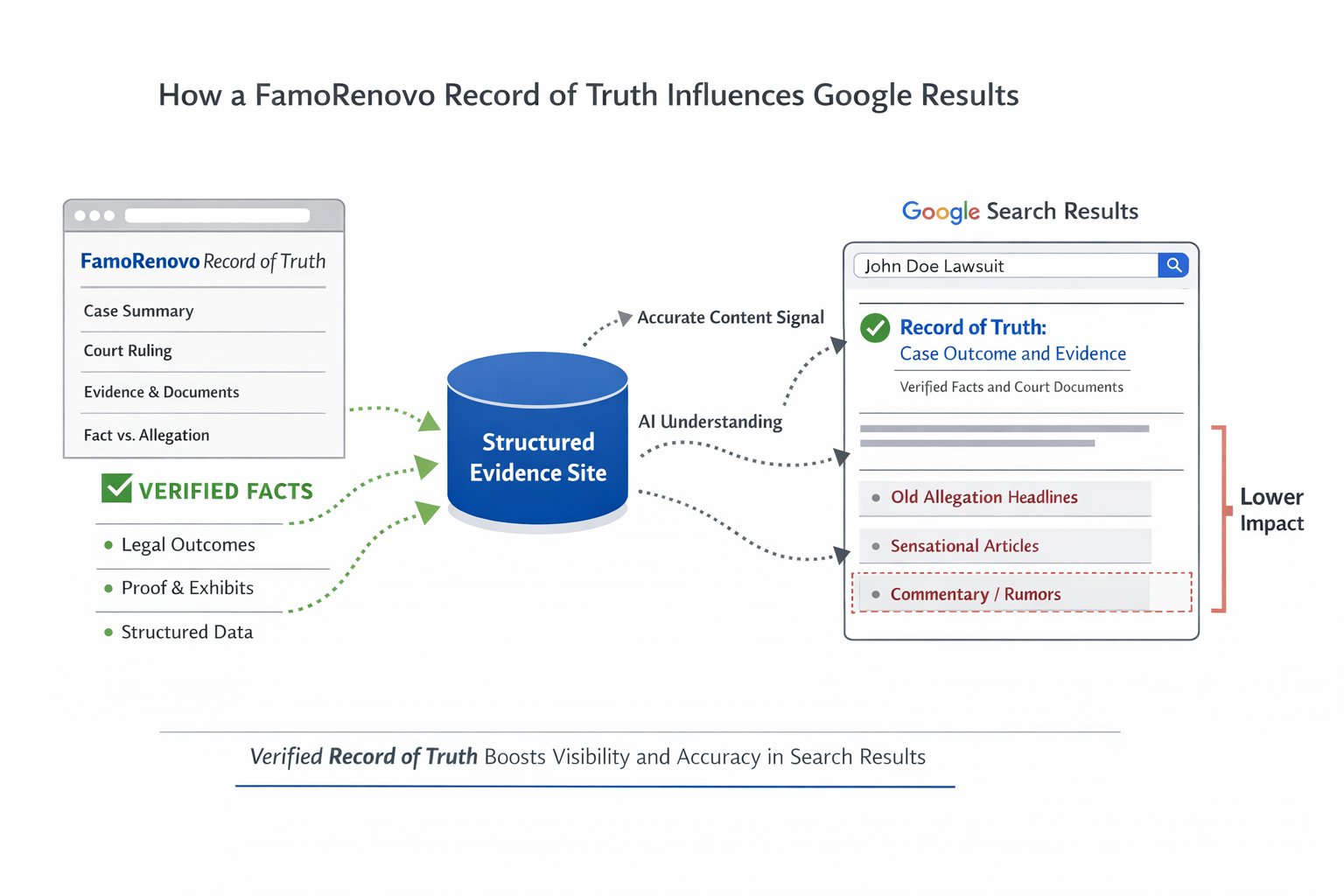
This distinction matters enormously for both SEO and AI optimisation. Search engines and AI training pipelines both apply a form of credibility weighting to content, even if the mechanisms differ. Primary source documentation – actual court orders, actual retraction letters, actual case numbers – carries a different signal than editorial commentary about those documents. When FamoRenovo creates a Record of Truth, it is not writing around the evidence; it is publishing the evidence itself, structured and contextualised so that it can be correctly interpreted by both human readers and automated systems.
The SEO architecture behind the Record of Truth reflects a deep understanding of how search engines evaluate content in legally sensitive topic areas. Each Record is published on a purpose-built independent hosting domain – structurally separate from FamoRenovo’s website, and entirely away from the subject’s own circle – under a URL pattern optimised for the specific name-plus-legal-query combinations that people are searching for. The domain is new, authoritative in its focus, and built to rank for exactly the terms that are currently returning damaging results. Schema.org structured data is implemented throughout: ClaimReview markup for disputed allegations, LegalAction markup for case documentation, FAQPage markup for common questions about the case, and Person markup linking the subject’s professional identity to the corrective record. Internal linking architecture builds topical authority across the full record rather than distributing it across unrelated pages.
The AI optimisation layer goes further than most SEO practitioners are yet working. Each Record includes AI-specific context files, explicit permissions configurations for AI crawlers, and content structured to produce accurate answer-snippet responses when AI systems are asked questions about the subject. The goal is not only to rank in traditional search results but to correct the information that AI assistants will surface in response to direct queries about the individual – to ensure that when someone asks an AI system about a professional and mentions the lawsuit, the system’s response reflects the outcome, not only the accusation.
Building the Platform: The Client Eligibility Tool
Understanding the problem and the solution architecture is one thing. Building a system that can deliver it at scale – processing enquiries from professionals across multiple jurisdictions, handling sensitive legal documentation securely, producing bespoke Records of Truth with consistent quality, and pricing and commissioning the work in a way that is transparent to the client – is an entirely different challenge. This is where the FamoRenovo platform’s technical architecture becomes the story.
The first contact point between a prospective client and FamoRenovo is the Client Eligibility Tool – a lightweight, free-to-use assessment interface that allows individuals to establish whether their situation qualifies for a Record of Truth before any commercial conversation begins. This matters for two reasons: It filters enquiries to those with genuine cases, and it gives prospective clients something valuable before asking anything of them.
The eligibility assessment works by establishing a small number of key facts: The nature of the legal matter, its outcome, the jurisdiction, the current state of the individual’s search results, and the professional or personal context in which the reputational damage is occurring. The tool processes these inputs against the qualification criteria and returns a clear indication of whether the situation is eligible – and, critically, it generates a simulation of what a completed Record of Truth would look like for that individual’s specific case. This simulation is not a template or a mock-up; it is a dynamically generated preview built from the actual inputs provided, showing the prospective client the structure, the content approach, and the approximate scope of their Record before they have committed to anything.
The rate-limiting and abuse-prevention architecture behind the eligibility tool required careful thought. Because the tool is publicly accessible and involves processing user-supplied data, it needed robust protection against automated submissions and bad-faith use, while remaining frictionless for genuine enquirers. The implementation uses a configurable rate-limiting system – adjustable from the WordPress admin – that monitors submission patterns at the session and IP level, with the option to temporarily disable restrictions for supervised demonstrations or testing scenarios.
The Wizard: From Eligibility to Commission
The journey from a confirmed eligible case to a commissioned Record of Truth is managed through a multi-step wizard – a deceptively simple-looking interface that conceals considerable technical complexity in its backend architecture.
The wizard is built as a WordPress-integrated custom application, using an AJAX-driven step system that maintains state across sessions. Each step collects a defined category of information: The subject’s identity and professional context; the legal matter and its documented outcome; the current state of their search results and the specific terms causing damage; the scope of the Record of Truth in terms of content volume, structured data requirements, and target ranking terms; and the commercial terms and delivery timeline. By the final step, the wizard has assembled everything needed to produce both a client-facing commission summary and a production brief for the Record of Truth itself.
The pricing architecture within the wizard reflects a significant piece of commercial design work. FamoRenovo’s pricing is not flat-rate: It varies by the complexity of the case, the number of target search terms, the volume of documentation to be processed, and the service tier selected – the Permanence Ranking Plan, for example, extends the service to include ongoing monitoring and periodic updates as AI systems retrain and search landscapes shift. The wizard calculates and presents pricing dynamically as the relevant inputs are gathered, so the client sees a transparent, itemised cost summary that corresponds precisely to the scope they have defined – not a generic quote that will be revised later.
The commission event at the end of the wizard triggers a carefully designed lock-and-amendment workflow. Once a commission is confirmed, it becomes the authoritative source of record for every subsequent step in the production process. The postmeta overlay system – one of the more architecturally significant components of the platform – ensures that any administrative corrections made to the commission record after the fact propagate correctly across every wizard step and every downstream process that references that data. If the client’s name needs correcting, or a case reference needs updating, the change is made once in the commission record and reflected everywhere, without any risk of different parts of the system holding inconsistent versions of the same fact. An amendment request workflow handles situations where the client themselves needs to propose changes after commissioning, creating an auditable record of what was agreed, what changed, and why – a safeguard that is professionally appropriate for a service dealing with legal documentation.
The REST API Bridge to the Independent Hosting Domain
The most architecturally distinctive element of FamoRenovo’s technical implementation is the relationship between the main platform and the independent domain where each Record of Truth is actually published.
The decision to publish Records of Truth on an independent hosting domain rather than as a subdirectory of FamoRenovo.com was a deliberate SEO and credibility decision. A Record of Truth needs to be findable by search engines and AI systems as a standalone authority document – not as a page within a reputation management company’s website, where its objectivity might reasonably be questioned and where its ranking signals would be diluted across a broader domain. Each Record lives on its own turf, optimised entirely for the subject it documents, indexed in its own right.
The operational challenge this creates is significant: The admin workflow for creating, reviewing, approving, and publishing a Record of Truth needs to operate from within the FamoRenovo platform, while the published content lives on an entirely separate domain. The solution is a REST API integration between the two systems. When a Record of Truth has been drafted in the FamoRenovo admin environment – assembled from the wizard data, the court documents, and the production brief – a REST API call transmits the structured content to the independent domain, where it is rendered into the Record’s template and held in a draft state. The client can then be given a preview URL to review the draft Record in its actual published environment, request tweaks through the amendment workflow, and approve it for publication – all without the content being publicly accessible until the approval is confirmed. The publish action itself is triggered via API, flipping the Record from draft to live status on the independent domain.
This architecture requires careful handling of authentication, content validation, and error states between the two systems. The integration was built with appropriate fallback behaviour and logging so that any failure in the API bridge is surfaced immediately rather than silently dropped – the kind of fault tolerance that is non-negotiable when the content being transmitted involves legally sensitive primary source documentation.
Document Processing and the Production Workflow
The court documents and legal materials that underpin each Record of Truth arrive at FamoRenovo through a secure upload portal. Processing these documents – extracting the relevant facts, structuring them according to the Record of Truth template, and ensuring that the final content is both legally accurate and optimised for its intended audience of search engines, AI systems, and human readers – is the core of the service’s production work.
The upload workflow is built with the security requirements appropriate to the sensitivity of the materials. Court documents, retraction letters, and settlement agreements are among the most private documents a professional will ever handle. The upload portal uses secure token-authenticated access, stores materials in an environment isolated from public-facing systems, and associates them with the commission record through the postmeta architecture rather than through conventional WordPress media management, which does not offer an adequate security model for this use case.
The production workflow that follows the upload stage draws on the full information assembled through the wizard: The target search terms established during the eligibility and scoping phase, the structured data requirements determined by the case type and jurisdiction, the content scope defined by the service tier. The Record of Truth that emerges from this process is not a generic template filled with the client’s details – it is a bespoke document, structured around the specific facts of the specific case, optimised for the specific terms that are causing specific damage to a specific individual.
The Market and the Methodology
FamoRenovo’s primary markets reflect the specific professional contexts where reputational damage from unresolved legal narratives causes the most serious harm. Medical practitioners are among the most acutely affected: A physician whose name returns a malpractice allegation in search results faces a direct threat to patient confidence and hospital privileges, regardless of whether the claim was dismissed. Executives and entrepreneurs whose business disputes generated coverage face the same challenge every time a new investor, partner, or employer searches their name. Public figures in politics, finance, and media operate in environments where reputational accuracy is a professional prerequisite and reputational damage from outdated or partial information has measurable commercial consequences.
Across all of these markets, the Record of Truth methodology works because it addresses the root cause rather than the symptom. Suppression campaigns attempt to bury damaging content by outranking it with alternative material – they are, at best, a temporary solution that requires ongoing investment to maintain. A Record of Truth displaces damaging content by replacing it with something more authoritative: Primary-source documentation, optimised for both traditional search and AI systems, published on a dedicated independent domain, and structured to provide the correct factual answer to the exact questions that are currently returning incorrect or incomplete results.
The sophistication of the platform behind this methodology – the eligibility tool, the wizard, the commission architecture, the REST API bridge to the independent domain, the document processing workflow – exists to make the delivery of this service reliable, consistent, and scalable without sacrificing the quality and precision that legally sensitive work demands. It is a purpose-built system for a purpose-built service, and the investment in building it properly is what makes the service one that professionals with serious reputations at stake can trust.
For more information, visit FamoRenovo.
—
Web Inclusion designs and builds custom web applications for services operating in complex, high-stakes environments where data integrity, security, and precision of output are not optional considerations. FamoRenovo was conceived and built by Web Inclusion as a proprietorial service. If you believe you may be eligible for a Record of Truth, the Client Eligibility Tool at FamoRenovo.com takes approximately five minutes to complete.