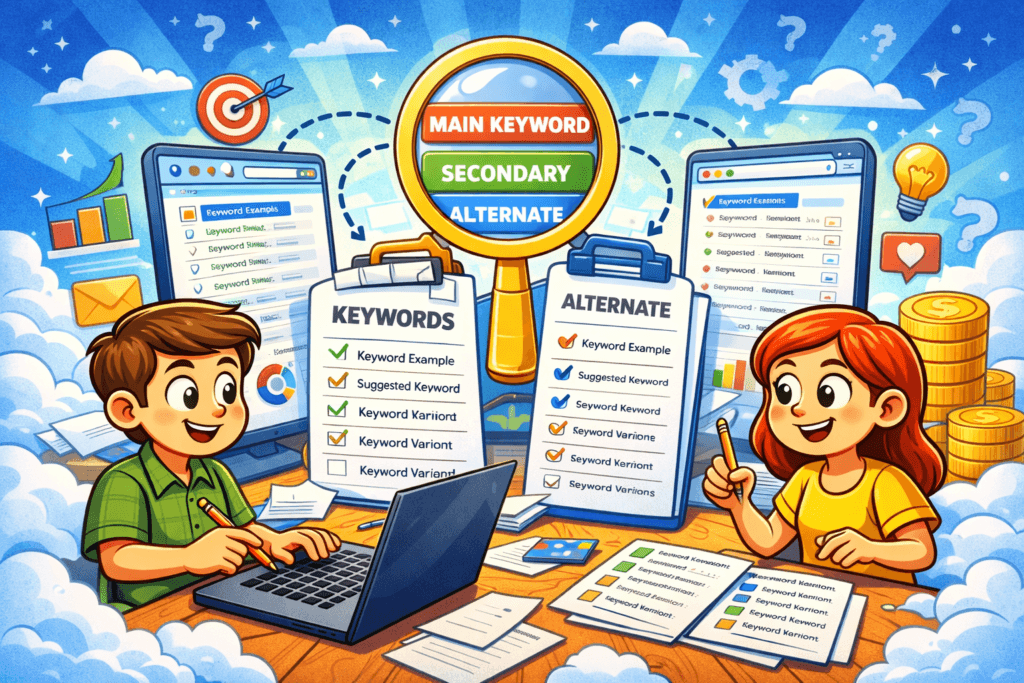
One of the most consistently underused techniques in SEO is the systematic identification of keywords associated with your target keyword. Most content strategies begin and end with a primary keyword — one term per page, optimised in the title and a few times in the body — and leave it at that. The problem with this approach is that it ignores the way search engines actually evaluate content relevance. Google does not assess a page purely by the presence of its target keyword; it assesses the semantic breadth of the page, looking for the related terms, concepts, and vocabulary that a genuinely comprehensive treatment of the subject would naturally include. Finding and incorporating the keywords associated with your target keyword is how you meet that standard.
This is not keyword stuffing by another name. It is the difference between producing content that appears to be about a topic and producing content that demonstrably is — across the full range of related language that your audience uses when they think and search about it.
Why Search Engines Look Beyond the Target Keyword
To understand why associated keywords matter, it helps to understand what search engines are trying to do. Google’s objective is to return the result that best satisfies the intent behind a query. Over the years, its ability to assess content relevance has shifted from simple keyword matching — how many times does this term appear on this page? — to a much more sophisticated semantic analysis of what a page is actually about.
This means a page optimised purely around a single target keyword, without the natural supporting vocabulary that the topic demands, can appear thin or superficial to a search engine even if it is technically well-written. Conversely, a page that comprehensively covers a topic — using the related terms, questions, and concepts that a genuinely expert treatment would include — signals depth and authority that simple keyword repetition cannot achieve.
The practical implication is that finding the keywords associated with your target keyword is not a supplementary activity — it is part of what defines the scope of content you need to produce.
Types of Associated Keywords
Associated keywords fall into several distinct categories, and understanding the differences between them affects how you use them.
Semantic variants. These are different ways of expressing the same concept. “Keyword research,” “search term research,” and “search query analysis” all describe fundamentally the same activity. A page optimised for one may be strengthened by incorporating the others naturally — not because they will necessarily each drive separate ranking positions, but because their presence signals to search engines that the page addresses the topic in its full linguistic range.
Subtopics and supporting concepts. An article about keyword research will naturally need to discuss search volume, keyword difficulty, search intent, and long-tail keywords — not because these are your target keywords, but because they are the constituent parts of the subject. A page that fails to address them signals a limited understanding of the topic. A page that addresses them thoroughly demonstrates genuine expertise.
Question-based variants. People search in questions as well as statements. “What is keyword research,” “how does keyword research work,” “why is keyword research important,” and “when should I do keyword research” all represent the same underlying topic in interrogative form. These question variants are particularly valuable because they often trigger featured snippets — the answer box at the top of search results — which delivers prominent visibility even before the standard organic results.
Synonym-adjacent terms. These are terms that are related but not identical in meaning — words and phrases that cluster around the same conceptual space without describing exactly the same thing. For an article about content strategy, terms like “editorial calendar,” “content planning,” “publishing schedule,” and “content distribution” are synonym-adjacent. Including them naturally signals topical breadth.
Co-occurring terms. These are words that frequently appear alongside your target keyword in other high-ranking content — terms that the topic consistently demands. Tools like Clearscope, Surfer SEO, and similar content optimisation platforms identify these specifically by analysing what language appears in the pages currently ranking for your target term. Including them in your content is a signal of relevance alignment.
How to Find Keywords Associated with Your Target Keyword
Google autocomplete and related searches. The simplest starting point requires no tools. Search for your target keyword and note the autocomplete suggestions — these are actual queries that people search for, presented in descending frequency. Scroll to the bottom of the results page and review the “related searches” section. Both surfaces reveal the associated terms that Google itself has identified as semantically connected to your query.
People also ask. The “people also ask” box in Google’s results surfaces question-based variants that are directly associated with your target keyword in Google’s semantic model. These questions are particularly useful for structuring the subheadings and sections of your content — answering them within the article directly addresses what Google knows a significant proportion of searchers want to know.
Competitor content analysis. Read the pages currently ranking in the top three positions for your target keyword and note the vocabulary they consistently use. This is a manual but highly reliable method of identifying the associated terms that the topic demands — if every high-ranking page on keyword research discusses search intent, keyword difficulty, and long-tail keywords, those terms belong in your content too.
LSI and co-occurrence tools. Tools specifically designed to identify latent semantic indexing terms and co-occurring vocabulary — including the content optimisation platforms mentioned above — automate the competitor analysis process at scale. They compare your content against the top-ranking pages and identify the associated terms present in those pages but missing from yours. This gap analysis is one of the fastest routes to improving a page that is ranking but underperforming its potential.
Your own Search Console data. Google Search Console shows you which queries are generating impressions for each of your pages, including terms you did not explicitly target. Queries appearing in this data that you are not yet ranking for are associated terms confirmed by Google itself — and updating your content to address them more explicitly can improve your ranking for both the original target keyword and the newly identified variants.
Incorporating Associated Keywords Naturally
The goal is topical comprehensiveness, not keyword density. Associated keywords should appear in your content because the content needs them to be complete, not because a checklist says they should be there.
In practice this means structuring your content to actually address the subtopics, questions, and supporting concepts that associated keyword research surfaces. An article that uses associated keywords naturally is one that covers its subject thoroughly from multiple angles — the kind of article that a reader finishes having genuinely understood the topic rather than just having had the target keyword confirmed at them repeatedly.
Subheadings are a natural location for associated keyword variants — they break the content into sections that can each address a specific aspect of the topic while introducing the vocabulary appropriate to that aspect. The introduction and conclusion are natural locations for semantic variants of the target keyword. The body of each section is where supporting concepts and co-occurring terms appear as part of the substance of the argument.
The result, when done well, is content that reads entirely naturally while providing search engines with the full semantic signal of expertise and comprehensiveness that they are evaluating for.
—
Web Inclusion’s content strategy work includes associated keyword analysis for every article and page we help clients produce. If your existing content is ranking but underperforming — appearing on page two or three without breaking into the top results — an associated keyword audit is frequently the fastest route to improvement.